MOSFET Body Diode and Reverse Recovery: A Buyer’s Checklist
Know which body-diode details to request before approving replacement power MOSFETs.
Published 4 November 2026 · Mosvanta editorial · Updated 4 November 2026
Where the body diode conducts in the application, compare its characteristics alongside the MOSFET switching requirements. Read recovery charge and time with their measurement conditions. A basic diode screening result does not measure dynamic reverse recovery. Ask engineering to review the exact candidate and retain that assessment with the supplier quotation.
Decision checklist
| Check | Evidence to request | Reason to pause approval |
|---|---|---|
| Circuit role | Determine when the body diode conducts | Comparing diode figures without application context |
| Recovery | Check current, temperature and switching conditions | Ranking time or charge with mismatched conditions |
| Screening | State exactly what the test measures | Continuity check called dynamic qualification |
Why the body diode belongs in the comparison
In circuits where the MOSFET body diode conducts, replacement selection needs more than voltage, current and on-resistance. The diode behaviour can affect the application during commutation. Ask engineering whether the diode is used in the intended operating sequence and which characteristics need to be compared.
Compare numbers with their conditions
Manufacturer documentation may specify diode forward behaviour, reverse recovery time and reverse recovery charge. These are measured under defined conditions. Do not rank candidates by a single recovery value without checking the associated test current, switching conditions and temperature information. Typical values and guaranteed limits answer different questions.
Keep drive and circuit behaviour together
Changes to a replacement device can affect switching behaviour in the surrounding circuit. Review the driver and operating conditions with the candidate device rather than treating the body diode as an isolated catalogue feature. Our gate-drive buying guide explains another part of that assessment.
Ask for an exact candidate
Provide the original complete MPN, manufacturer and package, and request the same information for any alternative. A similar marking or voltage category does not establish equivalent diode behaviour. Keep the manufacturer datasheet link with the quotation and identify unresolved differences for engineering approval.
Separate simple inspection from application validation
A basic diode check can contribute to screening, but it does not measure dynamic reverse recovery under the intended circuit conditions. Agree on the actual inspection scope and avoid interpreting a generic tested label as a full application qualification. Use our RFQ checklist to document evidence and sample requirements.
Explore the catalogue
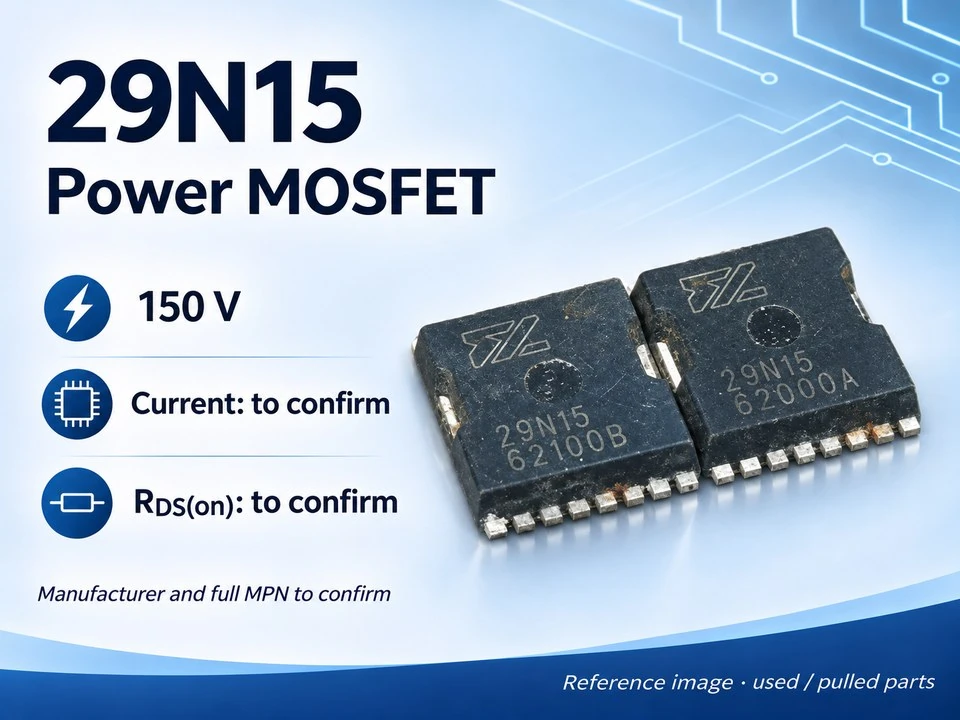
For a concrete catalogue reference, see 29N15 product information. The document image illustrates this catalogue entry; it does not establish suitability for the applications discussed. Confirm the complete identity and engineering requirements before ordering.
Source and next steps
Toshiba: body-diode characteristics. General selection guidance; confirm exact values in the manufacturer datasheet.
Browse our MOSFET directory and prepare your request with the RFQ checklist. Product workbook entries are sourcing references, not independent performance certification.
What should stop an order?
Pause approval when the full part identity, agreed condition or evidence needed for your decision is unresolved. Ask the supplier to clarify the specific gap. Keep the response with the order record so that a later buyer can see what was actually approved.