MOSFET Safe Operating Area: What Buyers Should Check
Understand why pulse duration, temperature and operating mode matter when comparing power MOSFET offers.
Published 4 November 2026 · Mosvanta editorial · Updated 4 November 2026
Safe operating area describes supported combinations of drain voltage and current under specified conditions. Check the relevant duration, temperature and operating mode in the exact device datasheet. Separate voltage and current maxima do not establish a valid operating point. Keep engineering approval attached to the complete part number and its documented requirements.
Decision checklist
| Check | Evidence to request | Reason to pause approval |
|---|---|---|
| Duration | Match pulse or continuous requirements | Extending a pulse curve to continuous operation |
| Temperature | Read curve assumptions and required derating | Ignoring the starting thermal condition |
| Lot approval | Inspect condition separately from design limits | SOA curve used as proof of used-batch life |
Voltage and current ratings are not a complete approval
A MOSFET may have separate headline voltage and current limits, but those limits do not describe every combination that it can withstand. Safe operating area, or SOA, describes combinations of voltage and current under specified conditions. Purchasing teams should keep the engineering assessment attached to the exact manufacturer part number rather than infer suitability from a short product listing.
Read the curve conditions
Ask the engineer to review pulse duration, temperature assumptions and the relevant operating mode in the manufacturer datasheet. A brief pulse curve is not evidence of continuous linear operation. If the required operating point or duration is not supported by the available documentation, obtain clarification instead of extending the graph by assumption.
Include startup and abnormal conditions
The review should cover the intended application conditions, including startup or current limiting where relevant. A device selected for low on-resistance during switching may need a separate review when it spends time at significant voltage and current simultaneously. See our replacement selection guide for the wider comparison.
Turn the review into a sourcing requirement
State the complete approved MPN and whether substitutions need fresh engineering approval. Record the datasheet revision and operating requirements used by the reviewer. A supplier claim that a part is stronger or higher current does not replace that review. For pulled parts, keep source and condition evidence separate from device-design qualification.
Approve a lot without overstating the evidence
Request identified lot images, agreed inspection records and sample approval terms. SOA documentation describes the device under its stated conditions; it is not a certificate of the remaining life of a used batch. Combine the design review with our incoming inspection workflow before releasing a bulk order.
Explore the catalogue
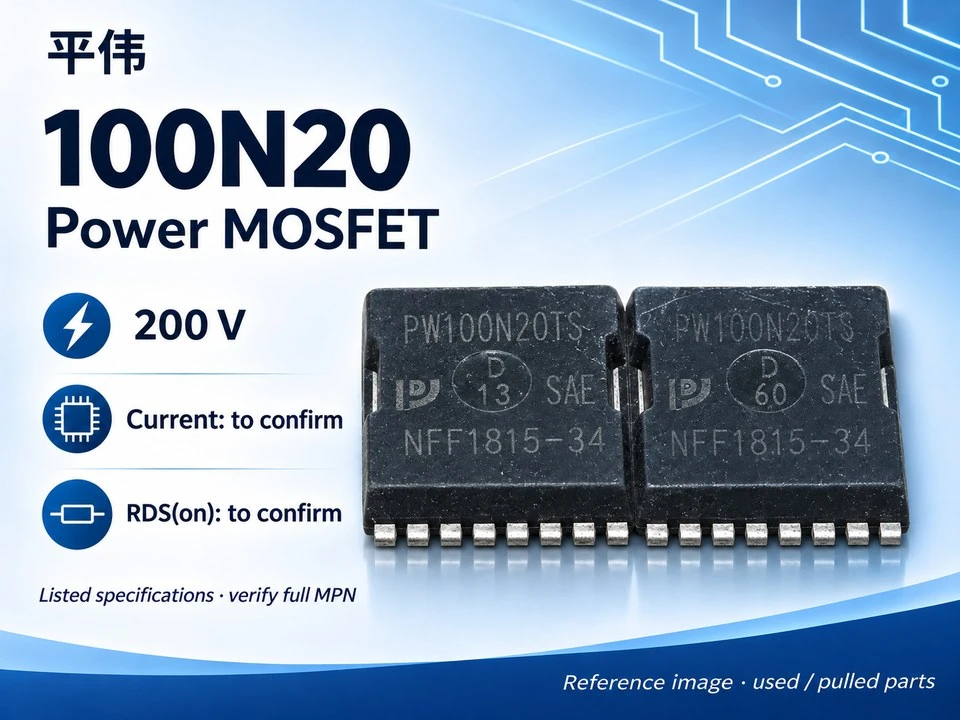
For a concrete catalogue reference, see 100N20 product information. The document image illustrates this catalogue entry; it does not establish suitability for the applications discussed. Confirm the complete identity and engineering requirements before ordering.
Source and next steps
Infineon: body-diode stress and SOA. General selection guidance; confirm exact values in the manufacturer datasheet.
Browse our MOSFET directory and prepare your request with the RFQ checklist. Product workbook entries are sourcing references, not independent performance certification.
What should stop an order?
Pause approval when the full part identity, agreed condition or evidence needed for your decision is unresolved. Ask the supplier to clarify the specific gap. Keep the response with the order record so that a later buyer can see what was actually approved.