How to Identify MOSFET Part Markings Before Ordering
Identify MOSFET markings with package details and manufacturer documents. Build a confirmed part-number record before requesting a used-component quotation.
Published 4 November 2026 · Mosvanta editorial
What does a MOSFET marking actually tell you?
A MOSFET marking is an identification clue printed or etched on its package. It may contain a shortened device code alongside production information. Confirm the manufacturer, package and exact ordering code using that manufacturer’s documentation before buying. A matching character string in a search result is a candidate, not a confirmed identification.
Step 1: Photograph the whole device
Take a sharp photograph of the complete marking, manufacturer logo and package. Capture the leads and underside where accessible, without damaging the part or assembly. Keep the orientation clear. If a character is uncertain, record it as uncertain rather than silently changing a zero to the letter O. A supplier can investigate an honest gap; a confidently mistyped code can send the enquiry toward the wrong part.
Step 2: Separate the visible text from your interpretation
Create two fields in your enquiry: visible marking and proposed full MPN. Copy the marking exactly, including line breaks in an attached note or photograph. Keep a proposed manufacturer or part number separate until evidence supports it. This simple distinction prevents a catalogue guess from becoming the purchasing specification when somebody forwards the message.
Step 3: Check the manufacturer and package together
Use the manufacturer logo and package information to narrow the search. Compare dimensions, lead count and the package drawing in the candidate datasheet. Manufacturers use their own naming and marking conventions; a rule learned for one product family should not be applied automatically to another. Toshiba publishes MOSFET part naming conventions, while Infineon provides package-specific marking documents. Use the relevant source for the exact candidate.
Step 4: Find the complete ordering code
Read the manufacturer product page and datasheet, including package and ordering information. Check suffixes instead of discarding them as unimportant. Their meaning depends on the manufacturer and device family. If the available document only confirms a family, keep the full ordering code unresolved and ask the supplier or manufacturer to clarify what can actually be established from the photographs.
A catalogue example from our supplied workbook
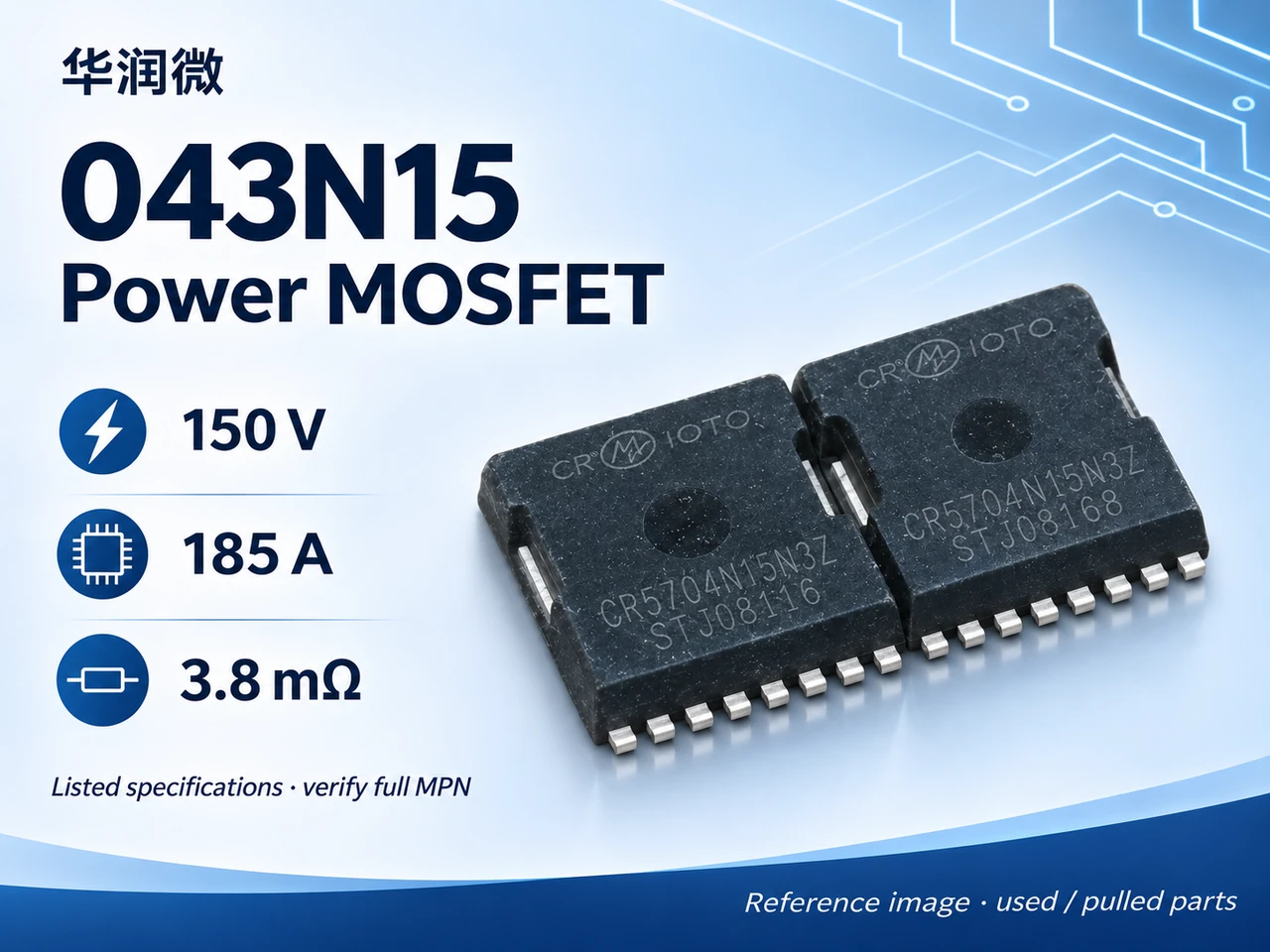
The workbook reference shown here is listed as 043N15 under 华润微. The product photograph contains more marking information than the short catalogue label. Preserve both records when investigating identity; this article does not infer a complete manufacturer ordering code from that label. See the 043N15 catalogue reference and confirm the full identity before treating it as an exact replacement.
Step 5: Review the application after identification
A confirmed identity still leaves an engineering decision. Compare the exact package and pinout, gate drive, relevant electrical limits and the circuit’s thermal requirements. Identification does not establish interchangeability. Our MOSFET replacement checklist covers that next stage. Keep the approval linked to the full MPN, not only the shortened top marking.
What should you send in the RFQ?
Send the original photographs, visible text, proposed or confirmed manufacturer, package information, full MPN status and required quantity. State whether alternatives need engineering approval. Request photographs of the actual offered lot so the supplier’s stock can be compared with the identification record. Use the used MOSFET RFQ checklist to add condition and inspection requirements.
Can a matching marking prove authenticity?
No. Matching text and a compatible package help identify a candidate, but they do not independently prove authenticity, previous service history or electrical condition. Review available traceability and actual lot evidence separately. For pulled components, follow the incoming inspection workflow and agree the inspection scope before ordering.
What if the marking remains ambiguous?
Keep the device unconfirmed. Ask for a clearer image or the supporting manufacturer document, and explain exactly which characters or suffixes are unresolved. Do not place an exact-part order against a guessed code. If your engineer approves an alternative, document it as a substitution with its own complete MPN and approval record.
Source and next steps
Infineon: example of package-specific marking documentation. General selection guidance; confirm exact values in the manufacturer datasheet.
Browse our MOSFET directory and prepare your request with the RFQ checklist. Product workbook entries are sourcing references, not independent performance certification.